For as long as I can remember, I’ve placed a lot of faith in my first impressions of certain significant people. These are people who either remind me of someone else or have a charismatic quality that makes me want to know them better. More often than not, I’ve followed those instincts and gotten to know the person. But before interacting with them, I would first build a huge story in my head of the kind of person they were and the kind of dynamic we would have.
The last person I had this impression of was a classmate of mine in my Masters’ program. She seemed popular, self-assured and impervious to others’ judgement of her. That made her uber cool in my eyes – and the person to get to know. Of course, it was important to play it cool (as if I knew how to do that)! She also reminded me of all the previous striking first impressions people. I thought that my life would transform once I got to know her.
It did, just not to the extent that I thought it would.
A halo effect occurs when we see someone in only a rosy, positive light. I loved doing that, because those people embodied certain characteristics that I craved to possess. Through my relationship with them, I expected to be more – more confident, more comfortable in my own skin, and ideally, worthy of being on someone else’s pedestal, preferably that of the person on mine. The downside to this is that by placing someone on a pedestal, we strip them of all human qualities. They don’t get to be their whole selves or deviate in any way from our version of them. As you might imagine, this is not a charade that can last long. The minute they mess up, we often feel disillusioned and heartbroken that someone we almost worshipped wasn’t worthy of it. What does that say about our judgement?
I’d been burned before. I knew that this was happening, and I placed safeguards, such as informing other people (who knew her better) of my possible obsession. These people were my reality checks. In focusing entirely on how I would become a better person for knowing her, I underestimated the amount of resilience I possessed to cope with her imminent crash from that pedestal.
We have a saying for this: time will heal all wounds. It feels oversimplified, because time isn’t everything. We could have all the time in the world, and still retain the intensity of feelings. Earlier, when the crashes would occur, I’d feel like a squished toy that would take a while to regain its shape. In getting to know this person and allowing her the space to be herself, I had to be willing to let go of my vision of her and my vision of the new and improved me, bit by bit. Surprisingly, it didn’t hurt the way I’d thought it would.
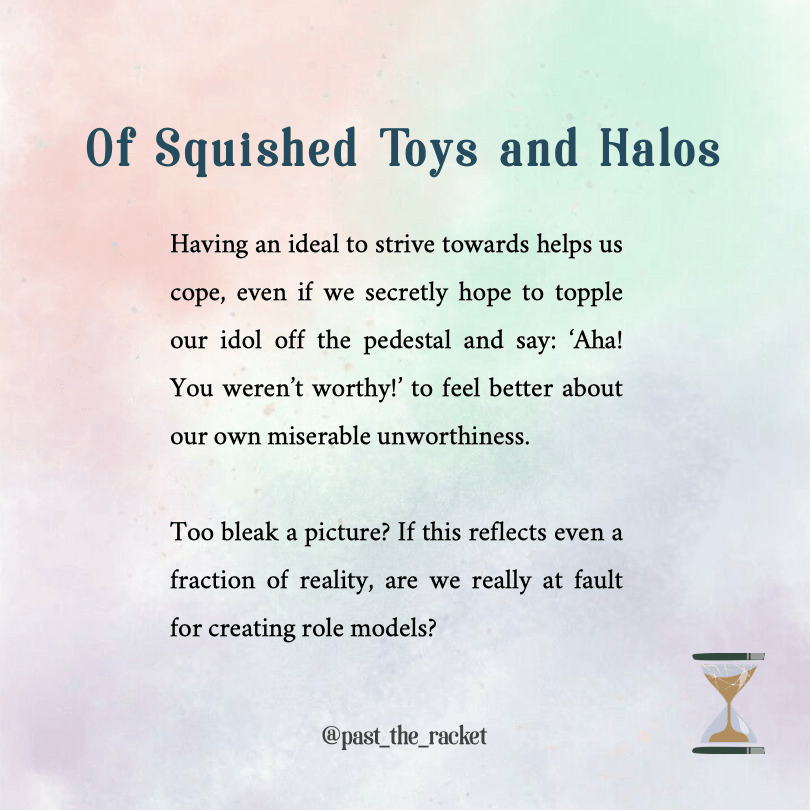
Maybe propping people on pedestals helps us cope with self-disappointment. Having an ideal to strive towards helps us cope, even if we secretly hope to topple them and say: ‘Aha! You weren’t worthy!’ to feel better about our own miserable unworthiness. It propels a cycle of idealism, motivation to gain those qualities, tiring of the struggle, resentment of the person on the pedestal, glee at their fall, and misery in coping with our inadequacy again.

Too bleak a picture? If this reflects even a fraction of reality, are we really at fault for creating role models?
At the start of 2019, I asked my therapist to help me build resilience, since I felt severely lacking in it. She asked me to define what it meant to me. My idea of it was to learn from my mistakes, to not repeat them, and to cope better. This idea stemmed from my fear that I might get squished beyond recognition and never regain my original shape. Now, I know that we adapt to adversity better than we realize. We’ve survived every setback that we’ve suffered and emerged with some wisdom. Just as we constantly adjust our expectations to reality, perhaps we could give ourselves more credit to transform and rise beyond our wildest dreams.
For years, I’ve carried around this halo that gets passed around from person to person, even if they never asked for it. For the first time, I feel comfortable in setting it aside. Now, it isn’t about me lacking all the qualities that the others have. Growth is me wanting to be more, while still being enough. As for that classmate of mine? She is one of my closest friends, and we laugh about the original mold that I expected her to fit into!

This article was written by Ms. Nandita Seshadri, therapist.
 Past the Racket
Little did I know that something called a halo cycle existed but, I can now relate to it very much after reading your post… very true and vibrant thoughts!!
LikeLike
Thank you so much! I’m so glad that you could relate to this 😀 Here’s to muses that come and go!
LikeLike