Featured

All Therapists are the Grinch (or at least, I am)

Tags: Therapy, Loss, Meaninglessness, Identity, Vulnerability, Loneliness, Doubt, Mental Health

Christmas Eve is here, and it’s that time of the year that sets off all kinds of contemplation that we are adept at otherwise avoiding.

I’ve become rather good at ignoring arbitrary markers of time as goal posts, but somehow, after holding it all together all year round, I too seem to be unraveling right now. 

What feels rather ironic is the cause for the spiral. That would be Secret Santa. You know, that fun, happy event where you get gifts from a secret someone leading all the way up to Christmas. Most people I know have been unwrapping presents received from Secret Santas. The only difference between the Grinch and I is that I’m living vicariously, while overcome by a wave of emotion that I’ve been hiding from all year. 

As a private practitioner, you’re working with clients in therapy by holding space for them to hold, nurture and express their emotions, their fears, their hopes and worries, the moments of joy and comfort that they create and hoard. You’re with them through this, and that’s where this role ends. Each session, I cherish and return the experiences that they’ve chosen to share with me and root for them. The most meaningful conversations that I’ve been a part of this year may have personal significance for those I’ve had them with, but I have no claim over those. And this time of the year, seeing people celebrate their shared connections, is making me resentful for having nothing to claim from all that meaning. Along with that is that tidal wave of loneliness. 

The loneliness in therapy is the fact that it is work. When clients say: ‘I don’t think anybody likes their job, except maybe you’, I feel, yes, I do like my job, because it’s meaningful. Is it enjoyable? I don’t know. Does it have personal meaning to me, or is that also borrowed? These aren’t questions I’d necessarily seen as separate from each other. When someone I’d been working with for a while said that they were worried they’d have to switch therapists, I felt blindsided, because I was hit with a sense of loss, which reminded me that I’m also human, and need to speak to my own therapist. It also brought to mind the imagery of being a stepping stone: that somehow, that might be all my role is.

Right about now, I feel like screaming into the void, and protectively cling on to all the meaningful conversations that added meaning to my life. Conversations that started because people were brave enough to express their doubt and were willing to sit with uncertainty. Now, there are more people willing to open up and have conversations, more support spaces to access, and yet, it might always be transactional. The only difference is, they can carry their meaning, and feel seen and heard, while I’ll hand it over to them, and pat myself on the back for having been a good therapist. The problem here is that being a therapist means working with emotions – the client’s and my own, and there are times when I’m questioning my competence as a therapist as well as my worth as a person, because all the work involves a significant aspect of my personhood too! 

I recently felt seen in a session, and I panicked. It’s bizarre how exposed I felt, and was overwhelmed by the urge to retreat and hold space for them, not me. To bypass any conversation that might feature me and say: ‘How does that make YOU feel?’ After all, I’m supposed to do the validating, right? How can that possibly accommodate me? Each time the urge to cite ethics or guidelines pops up, I’m becoming aware that I’m rejecting some part of human connection in me or the other person, because it’s shifting back to an impersonal hierarchical dynamic that was made by old, white men a few decades ago. 

So, there won’t be Secret Santas. There won’t be presents to guess the sender of, not naturally built into the system of work. To do that, I’ll have to put in the tiniest bit of extra effort, and right now, I don’t have it in me to do that. Because adults suck at making friends and opening up, except when they’ve been holding it all together all the time and finally let go. There is no more hiding from this loneliness, or the void. Because work is meaningful, but borrowed, and life isn’t work. And somehow, in urging people to question their wellbeing aside from work, I seem to have sidestepped the same for myself. 

Putting this out there feels like I’m a skinned grape, with the essence threatening to explode any second. Without realising, this year was all about exploration, and trying to make private practice work. Surprise, it did! I absolutely love what I do, and would not rather do anything else, but this is the closest I’ve come to walking away from it – the feeling that there’s no ownership over this, which leads to: What is mine, then? In all that doing, where was the time to just be? And now, that I’m just being, what’s here with me? And how do I make this stop? 

*Deep breaths* 

Alright. Time to stop. Hi there, loneliness. I’m done running now. 

Holding Our Breath – Why Languishing Isn’t an Option

A while ago, the New York Times wrote an article about how languishing is the descriptive phrase for our collective experience right now – where all the emotions that we are feeling right now, are about loss and processing. 

It was supposed to feel like a light bulb being turned on. Because last year, when the Harvard Business Review said that what we were going through was grief, it did feel like that – that the shock, denial, lack of understanding and trying to keep up with what was going on, understanding that a pandemic was happening – all of that did feel like grief. 

This year, languishing connotes that collective experience. Languishing seemingly suggests that we’ve come to terms with what’s happened and we’re processing it. This is true for the West, where vaccines have been rolled out, COVID-19 cases are reducing, and everything is opening up again. 

That couldn’t be farther from the experiences of the people I work with, or my own. 

In India, we’ve barely had time to process one thing before we have been hit with the next. Sure enough, we adjusted to COVID-19 on a functional level. However, we are far from thriving in it, and much closer to struggling for survival again. One year into the pandemic, we’re going through the second wave, and this is hitting us harder than the last one. It’s demanding more from us. Our attention. Our support. People are crowdfunding and engaging in collective action, which is exhausting, and inspiring and hopeful and encouraging and inspirational. Revolutionary, even. 

To club all of that under the umbrella term of ‘Languishing’ feels inadequate for these varied experiences and emotions. Or even to say ‘Dormant’, when a glance at social media will show you the frenzy of action that’s ongoing. Both terms are valid for the collective experiences of the societies that they were written by. However, the current lived experience in India is starkly different from these. 

There’s so much against us and yet we are going on. We know what is expected of us, be it working from home, or looking for a new job, or funding to make ends meet.

Usually, at this point, I would present you with an alternative and say maybe this is what describes our experience instead. Yet, currently, I am also at a loss of words, because can there really be one word to describe what we are going through, especially when it’s not over yet? We can probably look back, maybe a few months from now, maybe when the worst is over, (if this is the worst) and say, ‘Hmmm, during that period, THIS best described the collective feeling’

But right now, words feel fall short of it. 

The collective is so much stronger than the individual and this has been one of the strongest reminders of it. 

It’s really unfortunate that it’s happening this way. 

Earlier, therapy sessions would start with a ‘How have you been?’ on both ends and then we would get to the concerns at hand. Now, that question bears little meaning. Responses range from: ‘I’ve been busy’ (a functional response), to ‘Meh’ (an accurate response to feeling overwhelmed), to ‘I’m hanging in there’ (with the pleading undertone of ‘How much longer do I have to?’). The most resonant response, however, is: ‘I don’t know.’ 

I’ve been feeling a sense of disconnect from my emotions. It feels like there’s a fog of nostalgia and defiant denial of the present that is covering my emotions, rendering them inaccessible. Our emotions lurk underneath, demanding our attention, demanding to be felt. Even feeling a bit of it, such as just the tip of the Iceberg of Emotions, feels scary, because how on earth will we deal with the iceberg itself

Fog of nostalgia for pre-COVID times + denial of current reality hanging over my mind, clouding my emotions

It isn’t easy for us to process our emotions and also keep going. 

When we move towards peeling off the layer of ‘I don’t know’ to take a peek at what’s underneath, we are met with significant resistance. Do we really want to find out how we feel? It is underlined with the fear that: ‘If I pause and actually look at how I’m feeling, I’ll break.’ 

And that makes sense. 

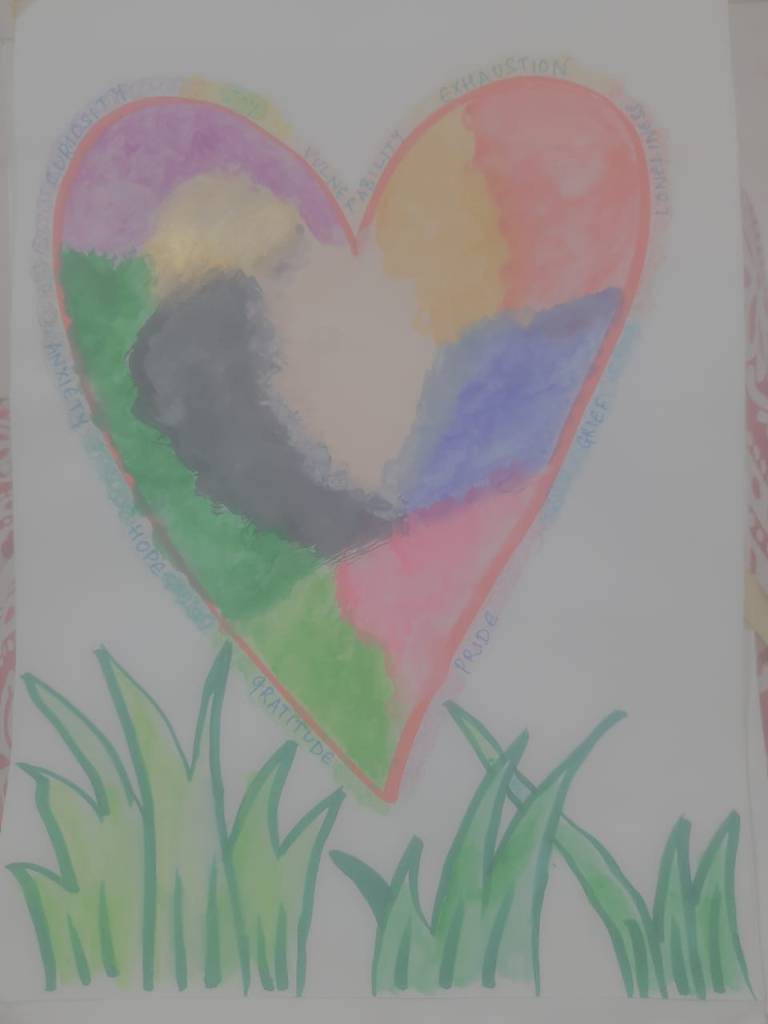
What’s in my heart, really?

We don’t know when that break is coming. 

We don’t know how long we can keep going because there is not a very clear end in sight. 

It’s like holding in a breath. And we start to release it, but something happened and we got startled. And we had to stop and hold it again. This feels worse because we had just started to release it. We had just started to feel okay about it. Now, we feel stuck and maybe that’s where we are. 

And maybe it’s okay to not define the stuck-ness right now. And to stay and get through this, or describe it for ourselves on a day-to-day basis rather than having a lasting definition, until we find something. Maybe the real question isn’t: How do we deal with the iceberg of emotions? Because we don’t have to, yet. Let’s just deal with the tip that’s accessible. The rest can happen as it does, slowly, in time. Maybe right now, we need more qualitative language. Maybe there is no rush to name our collective experiences or try to fit them under a currently inadequate umbrella term. Maybe we really, really, really need to expand our vocabulary and shift our lifestyles and keep finding ways to make the going a little bit easier, however we can cope, because nothing prepared us for a pandemic. 

And yet, here we are. 

Getting through one.

Although the actors are exhausted, the show keeps going on. 

Musings & Conversations in 2020

Endings come with a sense of wistfulness for the period that’s over. The awareness that things will never be the same again, because we are no longer the same people. Free will is often overwhelming – the knowledge that we can make some decision that could drastically alter our lives at almost any point is too much to take in. So, we wait for occasions where this kind of change is warranted. The end of a relationship can signal a change in hairstyle. The end of a job can mean starting a course or skill-building. The end of the calendar year? It’s all of the above and so much more. It’s a mandated period for self-reflection, Spotify-wrapped, and it’s all around us. All the deflection we’ve done all year is no longer effective. 

This year has been unlike any other. With drastic reduction in physical and social contact, time felt almost meaningless. The only reminders were other people’s engagements and weddings, notifications from the trips that were cancelled and prompts from the undue number of courses that we signed up for to unlock our improved selves. New lockdown, new me. New month, new me. Every additional commitment served as another essential distraction from the helplessness, dwindling sense of hope and mounting anxiety for what the year would bring. 

In such a year, it feels futile to hold ourselves to the standards that we did (not that it stopped us). Rather than reflecting on milestones, here’s a smattering of musings and snippets from conversations this year: 

On comparison of milestones: 

  • Everyone is getting married! Even in a pandemic!
  • I know I’m focused on my career growth and all that but it would be nice to have companionship too 
  • How do I resist the urge to compare my productivity with others? 
  • The smoke screens are gone. How can everyone else be achieving things right now when I’m struggling to hold it together? 

On loneliness: 

  • Loneliness of isolation at new workplace in building professional relationships online. 
  • Loneliness in dating – What is all this texting leading to? Putting in all this effort, but not feeling truly connected.   
  • Loneliness at work – I only talk to my clients/students. My co-workers are just that – colleagues. No real friendships or social interactions the way a shared working space provides. 
  • Loneliness in waiting for a sign – any signthat things are going to be alright. 

On doubt and vulnerability: 

  • Everyone else has had their hearts broken and are now guarding themselves. I wish I had felt that pain too, so that I would be in the same space right now, instead of feeling so vulnerable. 
  • Have I made enough space for the grief of the loss of little things? 
  • Am I looking at the silver lining, or am I spreading toxic positivity? 
  • I’m doing all this self-work, I wish I would get some reward for this! 

Reflections: 

  • What privileges am I ignoring when I compare my progress with theirs? 
  • How will posterity treat us? What space will 2020 have in the grand scheme of our lives? Will this be a defining year? 
  • Are we in a Lost Generation kind of period – disoriented, wandering, directionless? 

Hope: 

  • Will the Roaring 20s come for us too? Are we going to be resilient and Carpe Diem after this? 
  • I tried more things this year than I ever have before! Who knew I had it in me, huh? 
  • In losing control over planning our lives, we focused on ourselves instead of the world and created moments that probably (hopefully) led to growth 
  • In a year of fog, we looked for lighthouses, and found sparks of light from fireflies 
  • Hope that this year, we’ve been planted, and we will see more visible growth soon enough 
Spotting the fireflies

It feels like an oddity that each year, we are willing to undertake transformations overnight, despite knowing the kind of toll it takes. It might be resolutions, or intentions, or minor changes, but we yearn for the accountability and structure that a new calendar year brings, even though very few of us actually stick to it. Despite the guilt or frustration it causes, we are willing to put ourselves out there over and over again and celebrate the new year, and embrace the fresh start. There’s a curious comfort in the knowledge that we are willing to believe in ourselves again, and give ourselves another chance. 

On 31st Dec 2019, I remember deciding: 2020 is the end of this decade, 2021 is the start of the new one, so I’ll save my excitement for then. Let 2020 be the period of transition for the new decade! (I’m surprised at how that worked out – amidst everyone cancelling this year, I felt a little bit at ease). At the beginning of the pandemic, when we were getting adjusted to wearing masks, I wondered how long it would take to get acclimatized to it, and decided: the day that people in our dreams are also wearing masks, we know it’s a part of our lives, because our subconscious has absorbed it too. (That hasn’t happened yet, thankfully enough)? At the end of 2020, I’m not filled with wonder or great expectations for 2021, but with a steady faith in our ability to deal with whatever comes our way. That feels enough for now. Hi New year, you have my very current self to deal with.

*Massive sigh*

Embracing the Chrysalis

A while ago, I wrote about how I placed people on pedestals and coped with their crashes from them. I thought that at least now, I had reached a time where I didn’t need to place people there anymore. Since then, I shifted to a place where I spent my childhood, a place I’d romanticized from the time I left as an idyllic summer afternoon, where you were so sure that you had enough daylight to keep playing until your heart’s content. This place, that I’ve visited a few times since then, has been frozen in mind as a midsummer day, with each return reinforcing that feeling rather than shattering it. I realize that while this wasn’t a person, having a place on a pedestal was an even safer option, because the odds of it screwing up were (hopefully) lower. 

We read about caterpillars retreating into their cocoons and emerging as butterflies. That transformation is so glorious and natural and all that we hope for. This is a natural process that has a clear beginning, middle and end. We know the charted-out life cycles of these creatures. What of ourselves? 

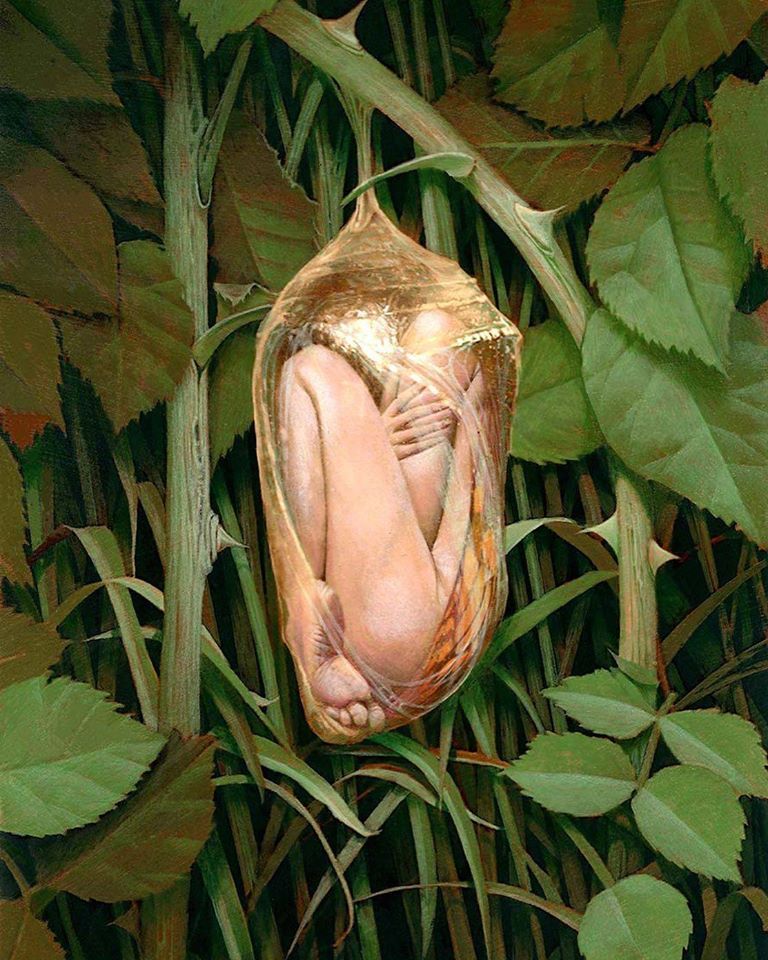
Artwork ‘Chrysalis’ by Ed Binkley

At twenty-one, I started my Masters in Applied Psychology – a course that was about unlearning and rediscovering ourselves. It was challenging with regard to the amount of self-work that went into creating mental health professionals. It had messy personal and collective struggles that none of us had anticipated. To deal with that onslaught of reflection, we retreated into our cocoons. We coped differently. Some of us dissected every aspect of ourselves and our pasts, others chose to shut it out altogether, some dipped in from time to time and so on. What mattered was that there was space for each approach. Even in the midst all our personal dramas, we were collectively building a space that accommodated all parts of ourselves and of each other. Today, I look back at that time and miss that space the most. 

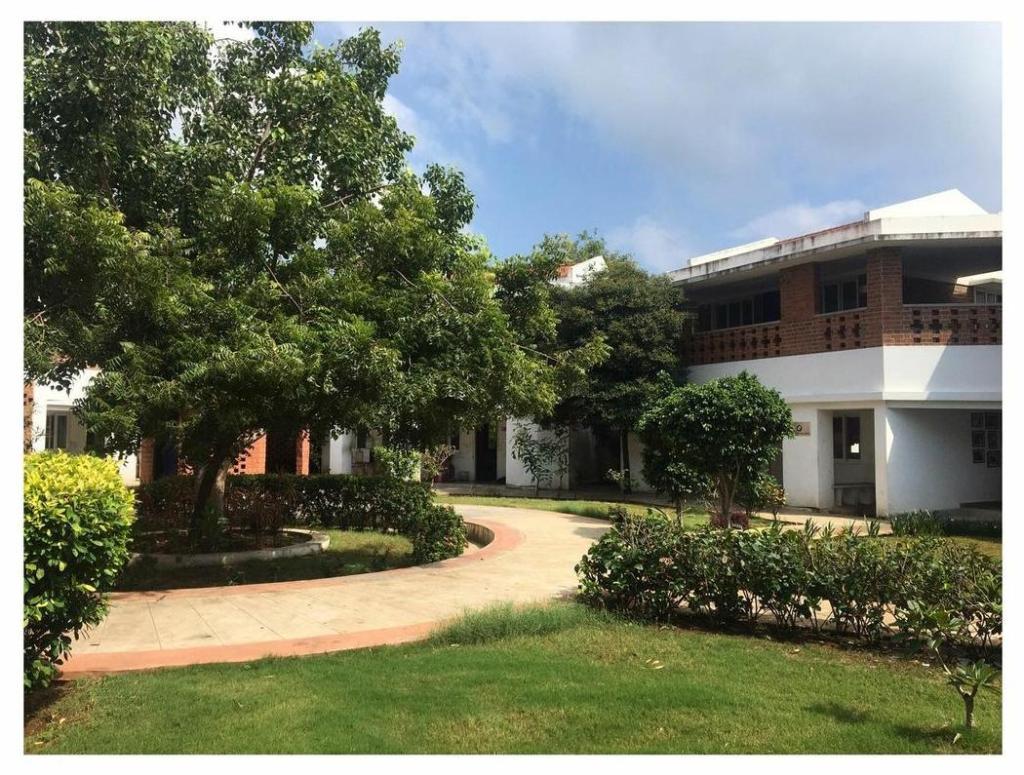
A beloved campus, holding numerous cocoons

The irony was that life afforded us that time (while we were removed from what felt like the rest of the world) to adapt however we chose. Reintegration was a challenge, because at the ripe age of twenty-three, we were expected to pay our dues by emerging as butterflies. 

The rude awakening was when we ran into our first crises at our respective places in the real world. There was no collective cocoon anymore. We had exhausted our subscriptions. We fumbled and fell and learnt more, without noticing the toll it took. We felt unsure, alone and terrified of being discovered as imposters. 

Musings of stories that I nurture within

There’s a simple answer to this. What if humans didn’t have to transform into fully-put-together beings at the milestone ages of twenty, or twenty-five or thirty or ever? Our undue focus on the metamorphosis and the goal is such that we forget the most important factor that contributed to it. Before the butterfly emerged, there was a period of rest and change. During that time, the caterpillar shed its past self and prepared for the future. In the safety of its cocoon, it had time to heal and grow. What if we too shifted our focus to create more safe spaces such as mini cocoons, where people can enter, rest, recharge and exit at will? Currently, the burden of finding or creating such a space is on the individual. Maybe someday soon, the milestones won’t wear us down as much. Maybe rest and healing can be enough. 

Newfound appreciation for sunrises & sunsets

As I spend time in this space, which is my equivalent of a personal cocoon, I’m resting, creating and exploring without the same pressure to perform. I’m strengthening this space with factors other than past memories – consciously channeling my desires and emotions into a space that accommodates all of me and enhances my growth. This collaboration feels like a triumph in itself, for I don’t expect to emerge complete – I feel whole right where and how I am – so different from what my twenty-one-year old self would have expected, yet every bit as satisfying. 

Of Squished Toys and Halos

For as long as I can remember, I’ve placed a lot of faith in my first impressions of certain significant people. These are people who either remind me of someone else or have a charismatic quality that makes me want to know them better. More often than not, I’ve followed those instincts and gotten to know the person. But before interacting with them, I would first build a huge story in my head of the kind of person they were and the kind of dynamic we would have. 

The last person I had this impression of was a classmate of mine in my Masters’ program. She seemed popular, self-assured and impervious to others’ judgement of her. That made her uber cool in my eyes – and the person to get to know. Of course, it was important to play it cool (as if I knew how to do that)! She also reminded me of all the previous striking first impressions people. I thought that my life would transform once I got to know her. 

It did, just not to the extent that I thought it would. 

A halo effect occurs when we see someone in only a rosy, positive light. I loved doing that, because those people embodied certain characteristics that I craved to possess. Through my relationship with them, I expected to be more – more confident, more comfortable in my own skin, and ideally, worthy of being on someone else’s pedestal, preferably that of the person on mine. The downside to this is that by placing someone on a pedestal, we strip them of all human qualities. They don’t get to be their whole selves or deviate in any way from our version of them. As you might imagine, this is not a charade that can last long. The minute they mess up, we often feel disillusioned and heartbroken that someone we almost worshipped wasn’t worthy of it. What does that say about our judgement? 

I’d been burned before. I knew that this was happening, and I placed safeguards, such as informing other people (who knew her better) of my possible obsession. These people were my reality checks. In focusing entirely on how I would become a better person for knowing her, I underestimated the amount of resilience I possessed to cope with her imminent crash from that pedestal. 

We have a saying for this: time will heal all wounds. It feels oversimplified, because time isn’t everything. We could have all the time in the world, and still retain the intensity of feelings. Earlier, when the crashes would occur, I’d feel like a squished toy that would take a while to regain its shape. In getting to know this person and allowing her the space to be herself, I had to be willing to let go of my vision of her and my vision of the new and improved me, bit by bit. Surprisingly, it didn’t hurt the way I’d thought it would. 

Maybe propping people on pedestals helps us cope with self-disappointment. Having an ideal to strive towards helps us cope, even if we secretly hope to topple them and say: ‘Aha! You weren’t worthy!’ to feel better about our own miserable unworthiness. It propels a cycle of idealism, motivation to gain those qualities, tiring of the struggle, resentment of the person on the pedestal, glee at their fall, and misery in coping with our inadequacy again. 

Too bleak a picture? If this reflects even a fraction of reality, are we really at fault for creating role models? 

At the start of 2019, I asked my therapist to help me build resilience, since I felt severely lacking in it. She asked me to define what it meant to me. My idea of it was to learn from my mistakes, to not repeat them, and to cope better. This idea stemmed from my fear that I might get squished beyond recognition and never regain my original shape. Now, I know that we adapt to adversity better than we realize. We’ve survived every setback that we’ve suffered and emerged with some wisdom. Just as we constantly adjust our expectations to reality, perhaps we could give ourselves more credit to transform and rise beyond our wildest dreams. 

For years, I’ve carried around this halo that gets passed around from person to person, even if they never asked for it. For the first time, I feel comfortable in setting it aside. Now, it isn’t about me lacking all the qualities that the others have. Growth is me wanting to be more, while still being enough. As for that classmate of mine? She is one of my closest friends, and we laugh about the original mold that I expected her to fit into! 

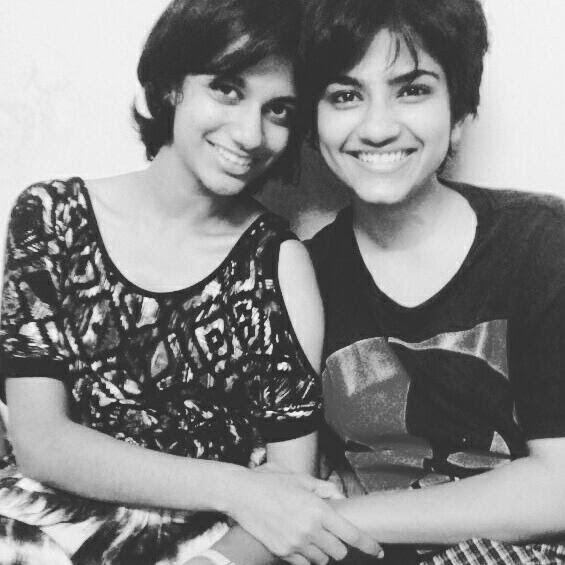
She who survived the pedestal and knocked it down instead!

This article was written by Ms. Nandita Seshadri, therapist.

An Ode to Gossip-Enablers

‘I heard a rumour’ is Allison’s superpower on Umbrella Academy. ‘Rumour has it!’ is Adele’s superhit track. Love might make the world go round, but intrigue has motivated human action and shaped our history. Disney movies might convince us that anthropomorphized animals gossip as well, but that’s a claim that needs verification. 

Researchers studying the brains of animals and humans found differences in their responses to danger. While reptiles categorised stimuli in black and white terms of dangerous vs harmless, animals included attachments and emotions in decision making. Humans included all this as well as reasoning and imagination. 

These findings helped understand animal responses. When a peacefully grazing deer is chased by a lion, it shifts from being at ease to running for its life. Upon outrunning its predator, it returns to graze without further ado. 

Any such instance that would come as a shock to a human would not be treated as lightly. To go from safety to endangerment without warning is traumatic for us. This goes beyond trauma, since anything out of the ordinary is a big deal for us and requires some processing. Think of some juicy gossip of someone’s wedding, a celebrity scandal or a to-die-for cat video you saw online. We promptly forward it to select others, and have separate venting sessions or lively discussions with each of them. It’s our way of restoring equilibrium in our life. Before this experience, our life was a ball of clay bearing some shape. This new piece has to either fit into that shape and enhance it, or blend in, or be discarded. With the constant bombardment of information and stimuli that we encounter, that ball of clay is an ever-changing entity. How then do we process this information? 

There’s one piece of the puzzle that ties it all together. Upon outrunning the lion, the deer goes and vigorously shakes itself next to a bush, AND THEN goes to graze. This seemingly simple action is the deer’s closure from this experience – so that there’s nothing left over. You see, the deer doesn’t develop PTSD and stop grazing. It deals with one threat at a time. 

When I learnt this theory, it felt ironic that humans’ need to make meaning out of patterns has also led to anxiety and mood disorders. With so many patterns to make meaning of, we turn to our loved ones to help decide what pieces to include and which to discard. When I get any gossip or come across a conspiracy theory (e.g. were Annie Murphy and Dan Levy a thing?!), I promptly call up Person 1: with whom I get this news off my chest. This action helps me clear my head. Then, I speak to Person 2: someone who will be equally excited and join me on the trip down stalking these guys across every social platform, whereupon we bandy even more outrageous conspiracy theories and compare the ethics of how Game of Thrones reshaped our generation’s attitude towards incest. This list isn’t exhaustive, because if it’s a classmate’s wedding or social media post, there may be any number of people involved with these steps getting rinsed and repeated. Finally, at some point, we engage in the human equivalent of shaking it off by drawing some (temporary) conclusion for a semblance of closure (until the next piece of gossip rekindles everything). 

I fondly think of the people I can have these discussions with and the roles that they play in being the keepers (and enablers) of my obsessions. Perhaps we can best make meaning and decode patterns in the company of other like-minded people. Maybe it is not such a bad thing that our prefrontal cortex stores patterns. Appreciate the beauty we sculpt with our clay! 

Herculean Labour – Romanticising Struggle

Once upon a time, I walked in to work feeling exhausted, with bags under my eyes and a cup of coffee to help me get through the morning. While scrolling through social media, I came across quotes such as ‘Your scars make you beautiful’, ‘You have to power through this, and it will all be worth it’, ‘The only way out is through’. While it was hard to imagine that my bloodshot eyes and sleepless state could be fixed by copious amounts of caffeine, these quotes reassured me that struggling is a part of human nature – with memes reinforcing that ‘The struggle is real’. Our struggles (or “first world problems”, such as getting enough sleep) are different from those of previous generations, but the experience of struggle remains constant. 

Upon a closer look, these new-age quotes are the same as the adages: ‘Try until you succeed’, ‘You won’t get it right the first time’, that the our parents and grandparents repeated to us all our childhood. Growing up, we heard stories of how people juggled multiple responsibilities to support their families and got an education simultaneously, to finally have it all pay off with a comfortable lifestyle at present. We look for inspiration from people’s success stories that embody a rags-to riches journey. It gives us hope that if they can do it, so can we. Hope that there is light at the end of the tunnel. However, do we really need to be in a tunnel in the first place?

Due to the saturation of struggle stories, our interpretation of struggle has evolved from it being inevitable and normal to being essential for our growth and the shaping of our identities. In trying to focus on the journey rather than the end, millennials have grown up believing that struggle is a part of life to be embraced and celebrated. 

This romanticism of struggle has led to a point where we do not appreciate or accept without being made to struggle for it. Essentially, if something has an easy way to it, it isn’t worth it. So, we devalue various things in life. Solo trips or backpacking will show us how to appreciate nature, solitude, find ourselves, and bring out our best because they require us to step outside our comfort zone. In reality, struggle can bring out the best, or it can crush us. There are other ways to explore life – the most difficult path need not have added value as compared to the others. 

The struggle mindset is best exemplified in our work culture. With being busy and being tired used as status symbols, millennials feel guilty for having something easy when others are struggling; and feel guilty for struggling so much when we are meant to be having it all. Both elements reinforce each other and leave us feeling perpetually exhausted and experiencing burnout. 

Millennial Lifestyle Cycle

Regardless of our state of being, guilt is a pre-installed feature that seems impossible to delete. If we experience a day without struggling with anything at all – be it work, work-life balance, or managing a household, we question ourselves about whether we’re doing it right, because ‘Things can’t be this easy naturally, for if it was, it would have no meaning.’ 

Millennials aren’t looking for happiness, we’re looking for meaning – that all this struggle is worth something in the end. It is no different from looking for redemption. The belief that our story is worth something only if it has a struggle in it, sucks us into the vortex of further struggle. Even if there’s a path out, we are so accustomed to the glorified struggle that we are blind to it or choose to turn away from the path. 

After viewing such a bleak picture, is there a way out of this? We have to contend with guilt and struggle, all while feeling exhausted. This is a steep, uphill climb. (With that statement, the struggle has been glorified even more). 

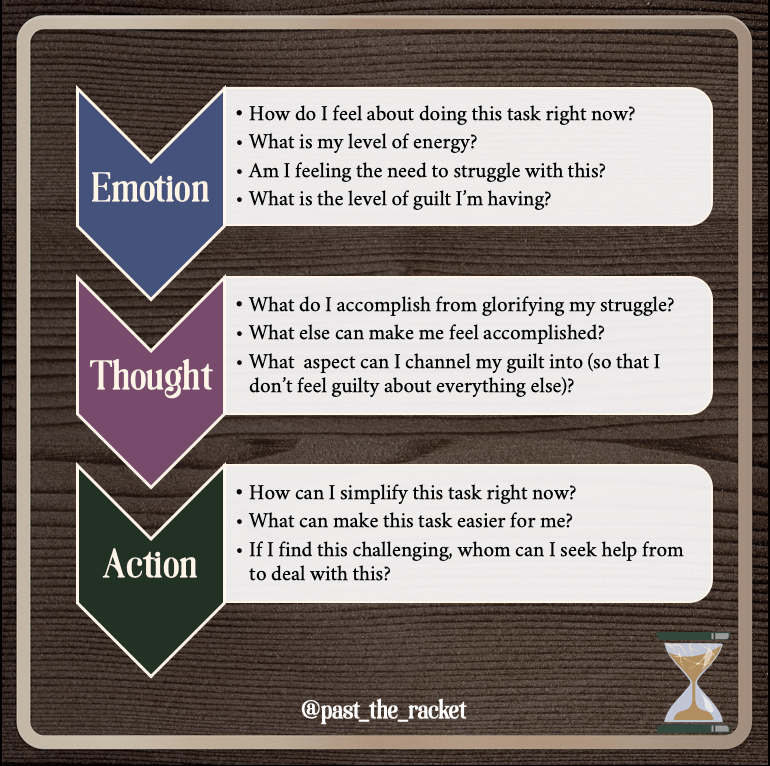
Dismantling this culture that has such intertwined elements means that tackling one will unravel the others. We need to identify and understand our need to struggle with guilt, question what we are getting from it, and look at how we can simplify our work further and achieve our goals with the least amount of struggle. In figuring this out, we can find ways to set boundaries for ourselves to contain our guilt and struggle, thereby minimizing our feeling of exhaustion. 

To check whether I’m struggling for the sake of it, I ask myself: How do I feel about doing this task right now? What can help me feel accomplished apart from struggling with this? What can make this task easier for me?

Mental check-in for signs of struggle

Rather than worrying about missing out on growth by taking the easy way out, we gain by becoming more creative (also known as jugaad) in our problem-solving approach, and that’s always a win. It is time to explore who we are and what we’re worth if we choose not to struggle. Even if what doesn’t kill us makes us stronger, do we really want to take that risk? 

Echoes of Worth

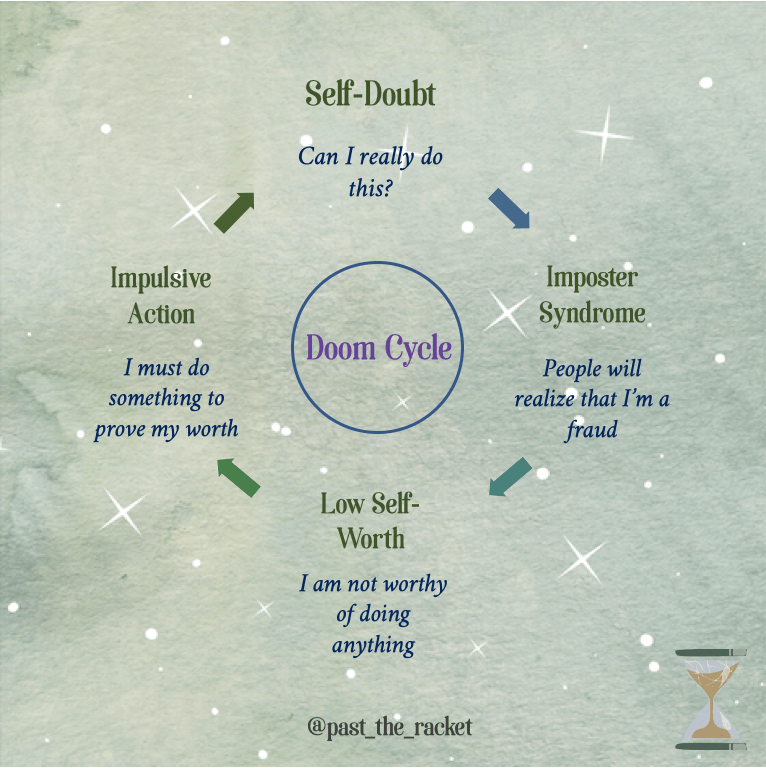
Recently, I was suddenly overcome by the fear and doubt of why I was being so vulnerable on social media, where it would be there for everyone to see and judge. Was this an imposter syndrome alert saying that I was not worthy enough to take up such space? Or was imposter syndrome the original feeling of being authentic on a social platform, saying that if I’m validated for what I express, I’m not an imposter? 

That inner voice has more questions: When I change and grow, will I look back on this and cringe, even if this is the best thing for me right now? Will everyone always see me as the junior therapist trying to navigate life, work and anxiety? 

Each time the feeling hit, I’d descend into this doom spiral. It would begin with the doubt, escalate to imposter syndrome and fear of being outed as a fraud. That would result in low self-worth which would prick at me until I took some impulsive action. That action would occasionally be constructive, which meant that I’d briefly feel good about myself before the self-doubt kicked in again. More often than not, that impulsivity would trigger the self-doubt all over again, leaving me tongue-tied to the questions of the inner voice. 

These questions are valid, I know that. This anxiety is about the legacy that I’m building for myself. Why legacy? Because even when I’m being myself, I’m hoping that this authenticity will give me the returns that’ll take me further. That some day, I’ll look back at this moment and say: ‘I was on to something’. I so dearly wish I had in this moment the conviction that only hindsight can provide. 

Today, I think it was cold-feet, that it was imposter syndrome which feared invalidation. I truly hope that something that feels so right in this moment won’t be tarnished by future me. I hope to show myself compassion even if I don’t quite understand why I really did this. Maybe it was to feel authentic, maybe it was to feel validated for that authenticity. Either way, I’d like to believe that I’m still deserving of compassion. That maybe, my legacy is not just what I’m envisioning and consciously building, but also includes the vulnerability, doubt and compassion to enhance all that is intentional. 

Bookworm No More

Harry wanders around with the sword of Gryffindor, while Celaena and Chaol voyage through underground passageways with me. My dreams reflect the parts of the books that I felt most connected with. Like you, I reminisce over childhood days of being a bookworm. We say: ‘I’m an avid reader’ out of habit, but there’s a frown immediately after, and a fervent hope that no one asks us what we’re reading right now. In reality, I’m in the middle of four books right now, and have been for a few months. Where are the days of me devouring book after book in an afternoon? 

When I think of my childhood, memories of two bookstores come to mind. One was a two-minute walk from my grandparents’ place where I’d spend my summer. We were allowed a limit of three books at a time for which we had to pay a deposit and had a reading charge. I would be their first customer at 10 a.m., and would select three Enid Blyton mysteries to take home. At 4 p.m., I would be back there to return the three adventures I’d just lived and to select another two that I would return at 8 p.m. and pick up a final one for the night. My cousin would sometimes accompany me but eventually favoured spending time with real people over fictional ones. Meanwhile, I couldn’t get enough of the worlds that I was pulled into. I never noticed how time flew by while I was on Kirrin Island or in Peterswood village.  

The other store was near home. On the way to my Maths tuition classes, I would stop by and borrow a few books. Maths never entered my head that much, so I’d hide the book under my notebook and read during class. The teacher had eight students to tutor, so my indiscretion escaped his notice. I’d hope that by the end of my class, I could return at least one book and borrow another. 

This voracious appetite for reading is something that many of us grew up with. We chose to dive into worlds that promised adventure and acceptance. We would feel proud when our parents introduced us to others as a reader. It was (a part of) our identity, and out of habit, we continue to say it. Yet, now there’s guilt that seeps in instantly. Usually, I can barely make it through three pages without checking my notifications or scrolling through some social media platform. Am I really worthy of calling myself a reader when I don’t really read that way anymore? 

I have come to realise that it is different for us as readers now. The standards that we set for ourselves earlier were where we had two options: interact in our imagination with fictional characters, or interact with actual people. Today, we have a multitude of options in varying degrees: Socialize on screen (passively through likes and comments; actively through texting, more actively through calls and video texts); take in more content (scrolling through videos, reels, photos, articles, news updates); live interaction with people around us. The paradox of choice is pretty overwhelming, and all these options are constantly present. How are we supposed to choose one and stick to it when we can shuffle between all? Why should we make that commitment at all? 

I have addressed my dilemma of reading in this way: I’m a reader, yes. I’m constantly evolving and rediscovering the art of reading, and my identity as a reader adapts accordingly. The last series that took me back to childhood reading standards was Throne of Glass in Jan 2020. Before that were bouts of  Harry Potter fanfiction that I descended into, to resurface in a week or so. I constantly plan and hope that I’ll find the perfect series that’ll transport me back to my childhood reading and attention state. In doing that, I’m depriving myself of the organic reading experience that ‘little me’ had. I’m coming to terms with being a reader in this age: a part-time one, or an occasional one, or even a “sort-of” reader. I’m relieved that even now, there are stories that captivate me, but my happiest resolution is this: In a world with so many choices, I choose to read as and when I want – and THAT makes me a reader. The rest? Well, I suppose I’ll see it in my dreams.

This article has been written by Nandita Seshadri, Therapist.

Being Sisyphus – Relapse in Recovery

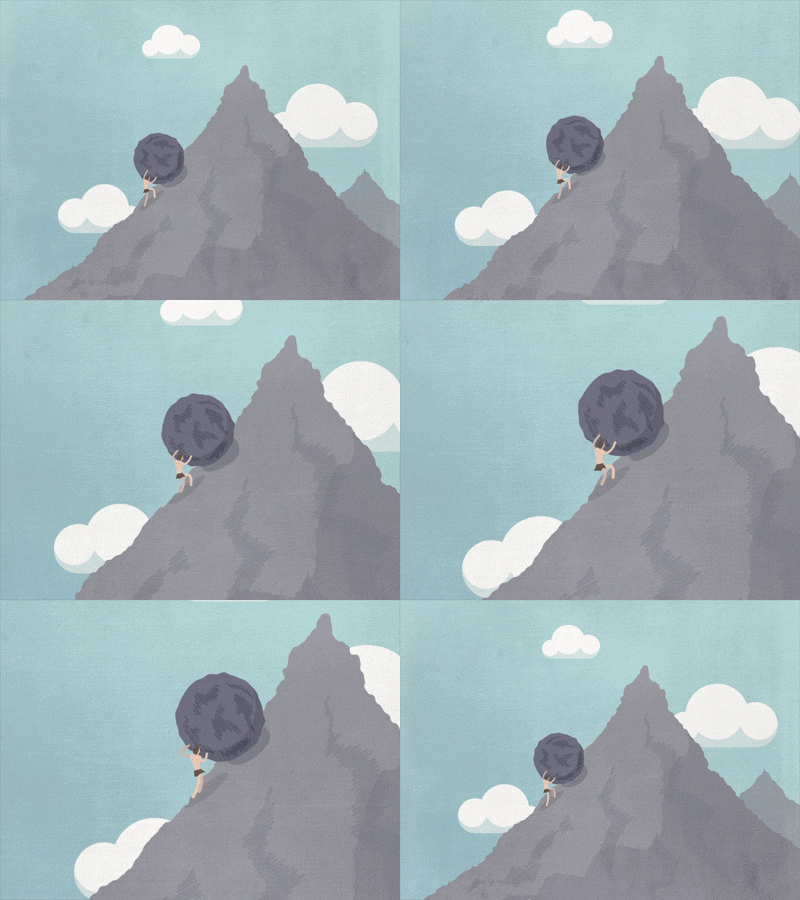
Gif courtesy: Pinterest

A couple of sessions ago, my therapist said: ‘Can we acknowledge that the last year has been hard?’ I was thrown by that comment. Nope, my year had been just fine. I was doing great at work (that was pretty much all I could think of). I didn’t understand that resistance that came up because that meant I had to admit that I didn’t get what I had wanted, when it was much easier to rationalise that what I had was what I’d desired all along. 

When the pandemic hit, I panicked. All my perfect plans of career growth had been derailed, yet again. One therapy session later I was ready to embrace the uncertainty and do my best again, and that feeling has mostly prevailed. I became super productive, because I was no longer resisting the uncertainty. Being in the field of mental health and content creation meant that I could channel all my inner frustration and create posts that resonated with others. Once again, here was my rationalisation to the rescue! 

The difference between anxiety then and now was that earlier, I knew my triggers and could manage them because they were clear and defined. Now, the game has no rules, and the goal is to not breakdown. Priorities shifted from levelling up to surviving. In this modified setting, how would I thrive? 

Some people are finding it difficult. Others find it easy and keep going, until they’re taken out by a surprise attack, and that keeps them down for a while. 
Personally, I find this setting easier. For a while, it feels like there’s a pause on the race to constant levelling up, and I’m not feeling threatened. Now, since it’s about survival, I can do whatever I want. I can create my own path. There’s so much more autonomy. With that, when I freeze now, I feel even more vulnerable than before. How can I be failing in both settings? When will I find my thriving point? 

When I can feel my mental health decline, I think of Sisyphus, the mortal who was cursed to roll a boulder up a hill over and over again. There’s no respite in that – you know when you get to the top that it’ll roll down again. Sometimes, you won’t even make it to the top. Every relapse would make me question all the progress I’d seen myself making over the years. 


It has taken me 4 months to understand that while the tide ebbs and flows, I have to accept that I’m not in superhero mode even in this setting. I’m still fallible, and I still need some time. The best part now is that while the goals to level up remain frozen, I get to redefine mine, and to do that, I need to give myself the space to be vulnerable and figure out what I want. Recovery is still a process, and not the goal I thought I’d reached. The difference now is that I know what I’m looking for. I have more clarity. Step 1 to that is to admit: Yes, last year was horrendous on an emotional level, and this year objectively being that way feels a lot less horrible for me. That, is progress. And it’s progress enough to keep me hopeful about what I do next. 

This article has been written by Nandita Seshadri, Therapist.